
Airspace and Perimeter Security: A Cross-Sector Year in Review

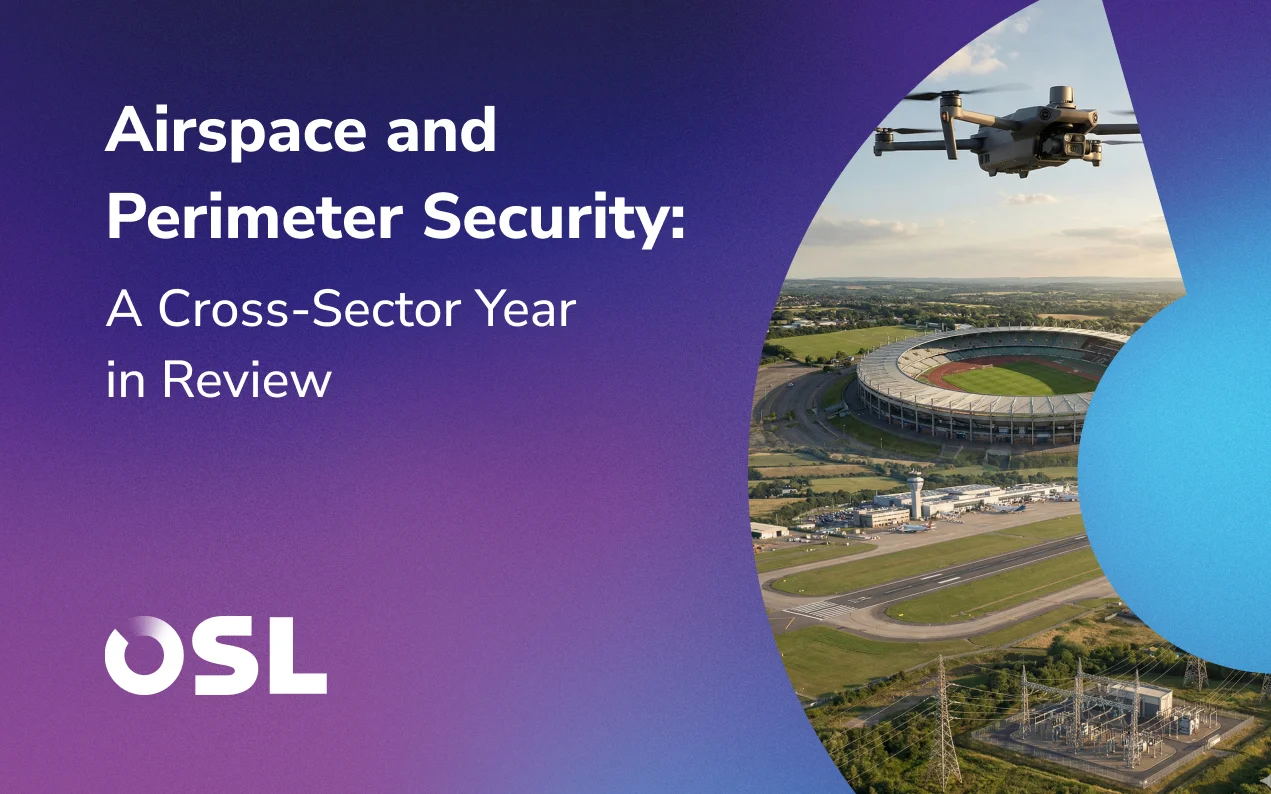
The past year marked a quiet shift across airspace and perimeter security. Although the environments differed, operators in airports, energy facilities, defence bases, stadiums, and border regions found themselves working through increasingly similar challenges. The emerging picture in 2025 formed a broad CUAS industry overview, defined not by dramatic escalation but by convergence.
Across sectors, workflows began to align, and the wider CUAS operational landscape moved towards shared expectations and methods for understanding what was actually happening in the environment. This review provides insights into the CUAS sector throughout the year. It outlines the CUAS operational insights, CUAS security trends, and wider drone security landscape that shaped work in 2025.
Rather than isolating individual incidents or focusing narrowly on equipment, the aim is to capture an integrated overview of the CUAS environment. This overview reflects what operators experienced across airports, energy sites, defence locations, stadiums, and border regions.
A More Blended and Uncertain Threat Picture
The threat picture in 2025 was shaped less by rising volumes and more by variety. Reconnaissance flights became more common, particularly around energy facilities and large public events, with activity often appearing days before people gathered on site. Modified and autonomous drones became more visible across the airspace security landscape.
These aircraft behaved differently from conventional emissions-based models, challenging library-dependent systems. This increased reliance on multi-sensor corroboration across the wider CUAS operational landscape.
The United States Federal Aviation Administration continued to receive more than one hundred reports of drone sightings near airports each month. These reports did not point to a dramatic rise in activity, but they did show expanding diversity in drone types and behaviours.
This trend mirrored the experiences of operators in other sectors, where the challenge was not the number of alerts but the ambiguity within them.
Another characteristic of the year was the increasing use of drones as part of a multi-vector activity. Aerial tracks often coincided with unrelated ground movement or unusual digital probing.
None of these elements was significant on its own, but together they created uncertainty. This reinforced the importance of understanding the full drone security landscape rather than reacting to single sources of information.
This reflected a wider CUAS sector landscape defined by complexity. Operators required a clear, trustworthy interpretation rather than an expanding volume of raw data.
Different Sectors, Very Similar Operational Pressures
Airports, energy sites, defence bases, stadiums, and border regions faced distinct pressures in 2025, yet their operational realities became increasingly aligned. This alignment formed a clear CUAS sector comparison that continued throughout the year and offered useful CUAS industry lessons.
Airports focused heavily on verification. Maintaining runway operations required confirmation that each alert was accurate and relevant. As we outlined in our analysis on post-alert airspace assurance, confirming that the sky was clear had become as important as identifying a potential threat, which we explored in detail in our review of post-alert airspace assurance.
Energy and critical national infrastructure sites placed greater attention on distance, context, and terrain. Many sit in complex environments where drones can approach from unexpected angles, while ground activity around perimeter fencing is often as relevant as aerial movement. In many deployments, the same sensors used for CUAS detection supported broader perimeter security tasks. This reflected a wider shift towards multi-domain security summary thinking and air and ground convergence.
Defence locations emphasised redundancy, modularity, and the use of multi-role sensors across varied landscapes. Lessons from overseas conflicts shaped expectations, but the underlying need for corroborated information mirrored civilian environments.
Stadiums and public venues dealt with short-notice deployments and consistent reconnaissance flights before crowds assembled. The most meaningful information often emerged in the days leading up to an event rather than during it. This highlighted the importance of understanding drone activity trends across a time window rather than focusing narrowly on event hours.
Border regions and remote facilities continued to expand remote operational monitoring. These sites face challenges in manpower and distance, and remote oversight improved consistency, documentation, and incident handling. This progression aligned with the layered thinking explored in our review of multi-layered defence across critical sites.
Across all sectors, similar pressures emerged. Non-library drones became more common. Multi-sensor corroboration became essential. Workflows became heavier. Ambiguity increased.
These shared experiences pointed towards a unified CUAS operational landscape.
How Technology Evolved: From Tools to Understanding
Technological progress in 2025 was defined not by new devices but by changes in how tools were used to interpret the environment. This formed part of the broader integrated security trends that became a theme of the year.
Multi-sensor fusion moved from expectation to requirement. Operators no longer accepted isolated sensor feeds or uncorrelated screens. They required a unified view that combined radar, EO, IR, RF, telemetry, and ground inputs. Fusion evolved into an interpretive layer that weighed the reliability of different sources and provided a single operational picture across airspace and perimeter security.
Artificial intelligence has developed into a support tool rather than a primary detection strategy. Instead of generating alerts, AI helped filter clutter, highlight relevant signals, and confirm environmental safety. This marked a shift towards mature, responsible use of automated reasoning, designed to reduce burden rather than replace human judgment.
The increased presence of modified and autonomous drones reinforced the importance of radar and optical sensors. RF detection remained valuable, but emissions alone were insufficient to fully understand the airspace and perimeter environment.
Industry studies reported continued cross-sector investment. Forecasts suggested that the CUAS market could nearly triple within five years, according to a recent market review. Reporting also noted increased procurement and heightened awareness across Europe and the Middle East, highlighted in a recent analysis by DroneLife. Taken together, these developments reinforced the wider CUAS environment overview that emerged throughout the year.
Operational Progress: Processes at the Centre
Operational improvements became a defining feature of 2025. Teams focused on verification, documentation, procedural clarity, and burden reduction, reflecting lessons learned across the CUAS industry overview.
Verification processes matured across all sectors. Alerts were treated as inputs rather than conclusions. Operators concentrated on determining what the environment actually looked like rather than reacting immediately to the first indicator.
Remote operational monitoring continued to expand, particularly across large geographical areas or sites with limited on-site staff. This created more consistent handling, stronger learning cycles, and more robust incident documentation, all of which contributed to a more disciplined CUAS operational landscape.
Operator burden reduction became a shared priority. Structured triage, clearer workflows, and fewer unnecessary alerts helped security teams maintain situational awareness during long shifts. Operational clarity carried more value than additional hardware.
A Converging Industry
By late 2025, it became difficult to view CUAS as a set of isolated sectors. The industry reflected a multi-sector security review, with airports, energy sites, defence bases, stadiums, and remote facilities aligning around similar technologies and interpretations of the environment.
Every sector required multi-sensor corroboration. Every sector needed air and ground visibility in a single operational picture. Every sector faced non-library drones.
Every sector depended on a C2 layer that supported structured, repeatable workflows. Every sector struggled more with clutter and ambiguity than with any single defined threat.
This convergence demonstrated a wider CUAS operational landscape that matured into a cross-sector discipline centred on integrated information and controlled decision-making.
Conclusion
The past year did not produce dramatic shifts in threat levels or breakthrough equipment. Instead, 2025 was defined by steady and meaningful progress. Operators became more disciplined, environments were understood with greater depth, and the CUAS sector landscape moved closer to a shared operational language.
Airspace and perimeter security will continue to evolve, but the developments of 2025 suggest a clear direction. Multi-sensor integration, verification-led workflows, and strong cross-sector operational practice are becoming the foundation for how critical sites understand their environment. A more unified drone security landscape is also part of this foundation.
The year showed that maturity often develops quietly. It appears in how teams work, how decisions are made, and how confidently operators interpret the picture in front of them.
FAQ: CUAS Sector Insights
What does this review aim to highlight?
This sector-wide CUAS analysis outlines airspace and perimeter trends. Plus, how security has evolved across multiple sectors over the past year. Instead of focusing on individual incidents or specific technologies, it highlights key operational themes. These themes consistently appeared across airports, energy sites, defence bases, stadiums, and border regions.
Why are airspace and perimeter security increasingly discussed together?
Many critical sites now face interconnected risks. Aerial activity often appears alongside ground movement. The same sensors used for CUAS detection also support wider perimeter tasks. This has led to a more integrated approach where air and ground environments are assessed together.
What changed in the CUAS threat picture over the year?
Threats grew more varied rather than more frequent. Operators observed more reconnaissance flights and more modified drones. They also saw a rise in autonomous aircraft that do not rely on known radio emissions. These changes increased ambiguity and led teams to rely more on sensor corroboration.
What are "non-library drones"?
These are drones that cannot be identified through RF signatures or known protocol libraries. Examples include modified aircraft, autonomous drones, and drones flown with hard-wired control systems. They require radar, optical, and multi-sensor fusion to be reliably assessed.
Why is multi-sensor fusion becoming essential?
Single sensor feeds do not provide enough context for today’s environment. Fusion allows radar, RF, optical, and ground data to be interpreted together. This creates a single operational picture that supports clearer decision-making.
Did any sector experience significantly higher risk than others?
Not necessarily. Each sector faced unique pressures, but the underlying operational challenges were similar: ambiguity, higher variety in drone behaviour, and the need for reliable verification. This convergence is one of the defining features of the year.
Why is verification becoming a central theme in CUAS operations?
Operators increasingly focus on confirming the true state of the environment rather than reacting to initial alerts. This reduces false responses, keeps operations running safely, and ensures decision-making is based on corroborated information.
How did operational workflows evolve across sectors?
Teams adopted more structured triage, clearer documentation, and more consistent processes. Remote monitoring expanded, and there was greater emphasis on reducing operator burden by filtering noise and prioritising high-quality information.
What role did AI play across the year?
AI shifted from generating alerts to supporting human judgment. It helped filter clutter, highlight relevant signals, and assist with environmental validation. The emphasis moved towards responsible, supportive use rather than automation for its own sake.
Why is the industry described as converging?
Even with different settings and risk levels, critical sites followed the same core principles. They relied on multi-sensor corroboration, a unified operational picture, strong verification, and structured workflows. These shared pressures have brought historically separate sectors closer together in practice.
What is the main takeaway from this cross-sector review?
The year's developments were defined by steady maturity rather than dramatic change. Across sectors, operators gained a clearer and more disciplined understanding of their environments. This progress is helping build a stronger, more unified CUAS approach in the years ahead.
What types of threats do modern CUAS systems detect?
Modern CUAS systems detect unauthorized drones, reconnaissance flights, payload-carrying aircraft, and autonomous drones that emit no radio signals. They also identify unusual flight patterns, airspace violations, and early signs of surveillance activity.
How do counter-UAS systems and counter-drone systems seamlessly integrate with existing security solutions?
Counter-UAS and counter-drone systems connect directly to existing security tools like CCTV networks and access-control systems. They merge these inputs into one operational picture and let teams manage airspace through a single coordinated workflow.
Do integrated CUAS platforms improve response times during drone incidents?
Yes. Integrated CUAS platforms improve response times by combining detection, tracking, verification, and alerting into a single workflow. Operators receive faster, clearer information, allowing them to assess threats and act without delay.
Editor's Pick
.avif)
Secure your airspace with adaptive drone defence solutions
Ensure operational safety with multi-layered solutions designed to counter unauthorised drones and protect complex environments.