
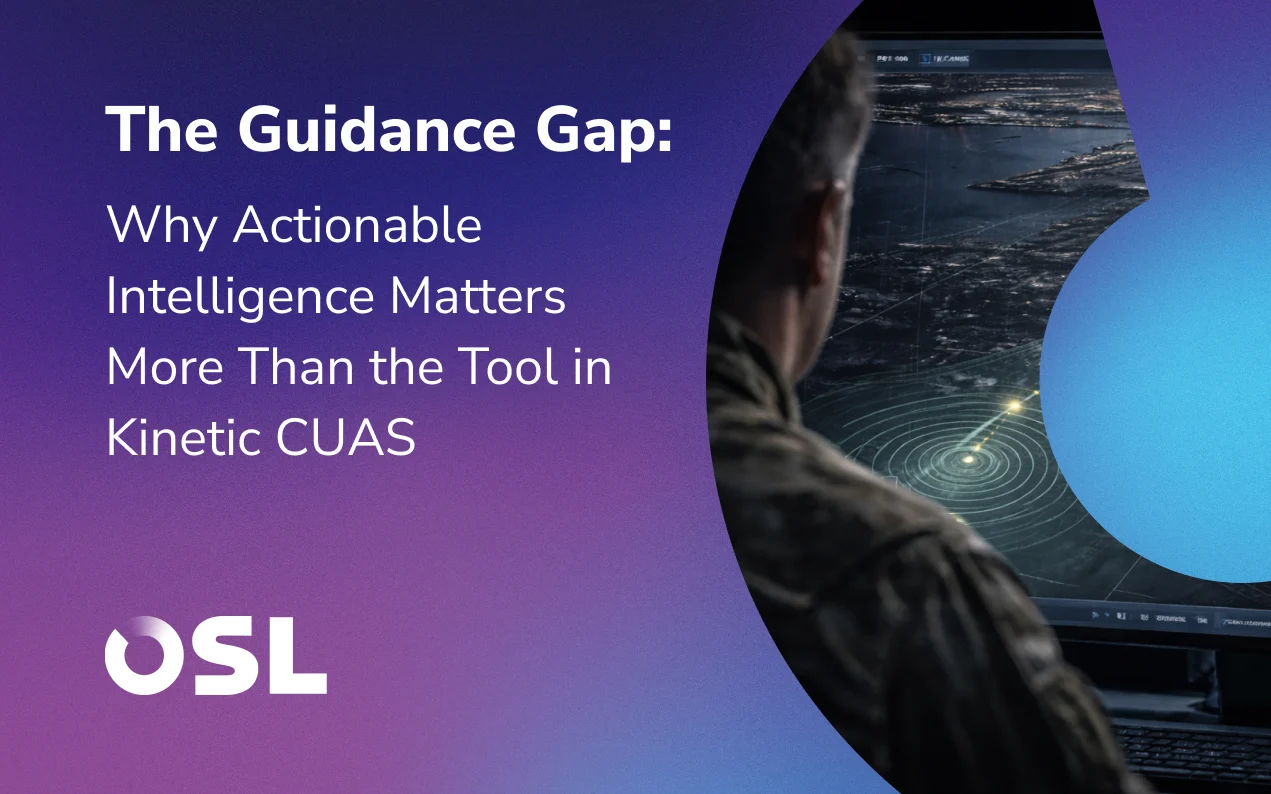
The Guidance Gap: Why Actionable Intelligence Matters More Than the Tool in Kinetic CUAS

In the landscape of modern airspace security, 2025 was the year of detection. 2026 is rapidly becoming the year of active mitigation. For those tasked with protecting Critical National Infrastructure (CNI) or military assets, the data is sobering.
According to recent reports, drone incidents near UK military sites more than doubled last year, with 266 recorded incursions. This surge in frequency has prompted a swift legislative response in the form of the Armed Forces Bill 2026. The bill grants personnel broader powers to defeat uncrewed systems across air, land, and sea domains.
As the legal red tape around active defeat begins to clear, the global market has responded with a flurry of hardware. We are entering the era of the interceptor drone: agile, autonomous platforms designed to physically neutralise threats where electronic countermeasures might be restricted or ineffective.
However, for security leads and operational commanders, the trend is not new. We have seen a steady shift toward physical interception as unauthorized drones become more autonomous and harder to jam. More than the availability of technology, the challenge today is the Guidance Gap between detection and a lawful intercept.
The Proliferation of the Interceptor Market
The Kinetic CUAS industry is currently in the midst of a hardware arms race. From net-slinging multicopters to high-speed kinetic strikers, the variety of effectors available is staggering. These platforms are masterclasses in aeronautical engineering, designed to be fast, resilient, and definitive in their results. Specialised interceptor drones demonstrate how far the physical capability of the industry has evolved.
However, an interceptor, no matter how capable, is essentially a "tool" in search of a mission. In a vacuum, a high-speed drone is a remarkable piece of kit. But in a busy, multi-agency environment like a UK airport or a maritime port, it's a liability if it lacks precise direction.
The industry has spent years perfecting the effector, but as we move through 2026, it is becoming clear that the success of any engagement depends entirely on the Actionable Intelligence for CUAS that orchestrates it.
Closing the Guidance Gap
The Guidance Gap is the critical space between a radar detection and a successful physical intercept. In a high-clutter environment, a blip on a screen is not enough to justify launching a physical response. The orchestration layer must handle the kinetic CUAS interception logic: calculating the optimal intercept path, assessing the risk of collateral damage or falling debris, and ensuring the response is proportionate to the threat.
For a kinetic response to be viable, it must be guided by high-fidelity Command and Control (C2) logic. This layer acts as the bridge, turning raw sensor data into Actionable Intelligence. As the official UK Government updates suggest, the responsibility to act decisively is growing. However, every action must be backed by verifiable, precision-guided data.
Sovereignty and the ‘Enhanced Tier’ Reality
Perhaps the most significant shift in 2026 is not technical, but regulatory. The National Security Act 2023 introduced the Foreign Influence Registration Scheme (FIRS). It includes an Enhanced Tier, a block of countries considered high risk to the UK's safety and interests.
In this new era, where your technology comes from is as important as what it does. When a C2 platform orchestrates a kinetic intercept, it handles sensitive data about national airspace and infrastructure vulnerabilities. Using technology from Enhanced Tier states for these "intelligence" functions poses unacceptable risks to data sovereignty and foreign influence.
Hence, operators must ensure secure CUAS data sovereignty and maintain a trusted CUAS supply chain (FIRS compliance) to protect sensitive information. A truly resilient defence strategy requires a Sovereign CUAS Capability: a software foundation developed and maintained within a trusted framework. This ensures that the logic guiding the intercept is secure, auditable, and free from external interference.
The Case for an Open, Interoperable Ecosystem
Maturity in the CUAS market is moving away from the all-in-one "black box." As drone threats evolve, the best interceptor today may not be the best interceptor in eighteen months. This is why the industry is shifting toward tech-agnostic CUAS command and control. By separating the intelligence layer from the hardware, organisations can maintain a consistent "brain" while swapping in the effective "tools" as they emerge.
This system-of-systems CUAS orchestration aligns with broader international standards, such as the European Commission's Action Plan on Drone Security. This plan emphasises trusted systems and the need for a single air display that integrates all relevant data. In 2026, the focus is on coordination. The goal is to create a seamless flow of information in which detection sensors, decision-making algorithms, and kinetic effectors work in concert to ensure operational interoperability across platforms.
Conclusion: From Buying Tools to Orchestrating Defence
The rise of the interceptor drone represents a natural progression in our ability to protect critical airspace. As frequency increases and the margin for error narrows, we must recognise that the interceptor is not the solution. Instead, it is the response.
True readiness in 2026 is measured by the reliability of the guidance system. It is the ability to fuse disparate data points into a trusted situational picture. This allows the system to calculate a safe engagement and guide a physical response with precision. It eventually ensures ethical CUAS decision support to operators.
By focusing on Actionable Intelligence, the industry ensures that every action taken in our skies is authorised, proportionate, and, above all, effective. The future of airspace protection is not about who has the fastest drone, but who has the most intelligent way to use it.
FAQs: Kinetic CUAS Guidance
1. Why is ‘Actionable Intelligence’ more important than the interceptor itself?
An interceptor is a tool that requires direction. In complex airspace, processing sensor data into a safe, precise path determines if an intercept can be executed legally.
2. How do the latest UK regulations affect Counter-Unmanned Aerial System (CUAS) procurement?
The National Security Act CUAS compliance 2023 and the Armed Forces Bill 2026 prioritise Sovereign CUAS Capability. Procurement is focused on ensuring that the software orchestrating these systems is secure from foreign influence and data leakage.
3. What is the benefit of a tech-agnostic CUAS command and control?
It prevents vendor lock-in. A tech-agnostic architecture lets a site use the best sensors and interceptors with a single, unified orchestration layer.
4. What is ‘System-of-Systems’ CUAS orchestration?
It is the process of linking separate technologies (radars, cameras, and drones) so they work together as one system. This lets data from one sensor accurately guide an interceptor from another manufacturer.
5. Why does high-fidelity CUAS situational awareness matter in kinetic operations?
High-fidelity CUAS situational awareness gives operators a precise, real-time view of the airspace. It shows the threat, nearby assets, and potential threat areas. This clarity allows systems to generate automated CUAS mitigation paths that are safe, proportionate, and legally defensible.
6. How do CUAS systems connect sensors and interceptors from different vendors?
Modern platforms use a multi-sensor CUAS integration architecture to combine radars, cameras, and other sensors. Cross-platform CUAS sensor fusion turns this data into a single operational picture that can guide all the interceptors.
Editor's Pick
.avif)
Secure your airspace with adaptive drone defence solutions
Ensure operational safety with multi-layered solutions designed to counter unauthorised drones and protect complex environments.