
The New Architecture of Certainty: Why Integrated Multi-Domain Defence Is Reshaping Airspace Security


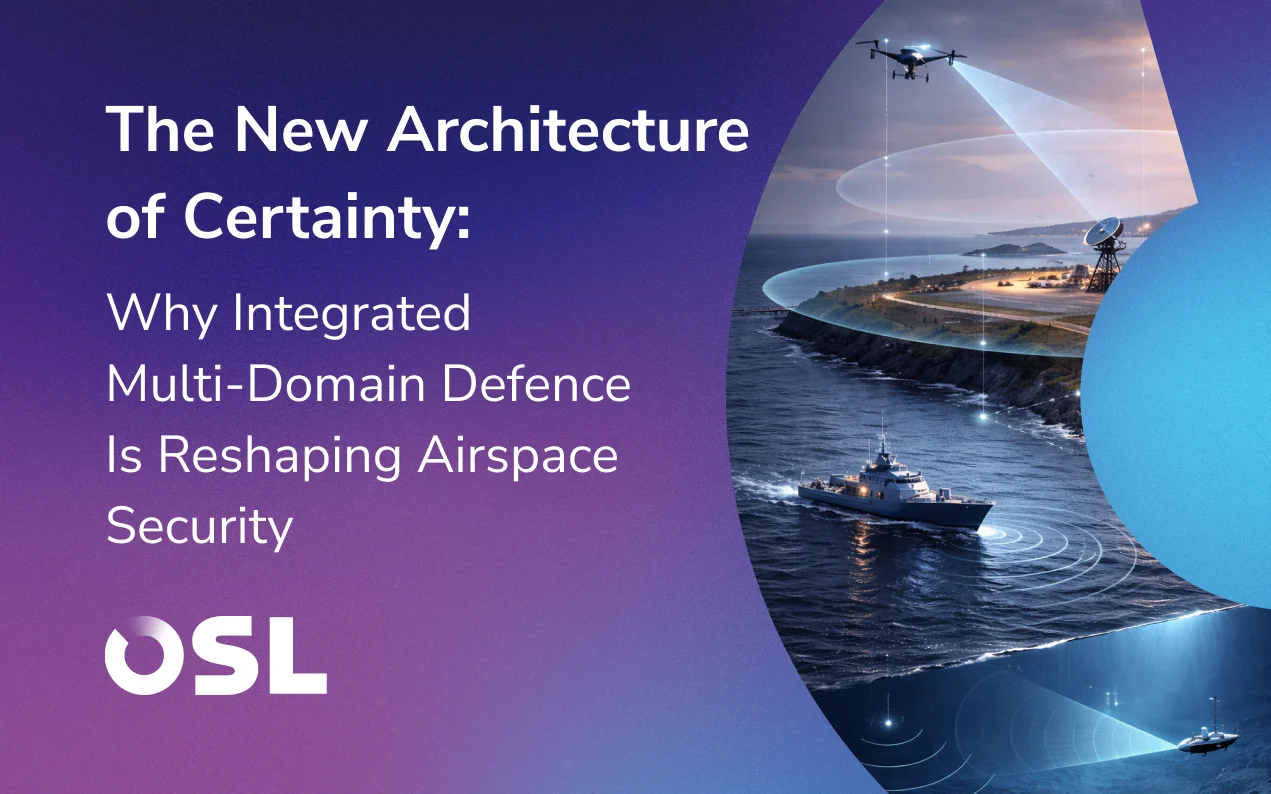
For decades, airspace protection evolved in layers that functioned largely as isolated silos. Air defence, ground surveillance, maritime monitoring, and command systems were traditionally procured and managed as separate capabilities. Each system was designed to solve a specific problem within its own technical boundary. While this fragmented model worked when threats were predictable and isolated, a new operational reality is now outpacing it.
What has changed is not simply the speed of emerging threats, but their fluidity across domains. In our recent work with international security leads, we consistently hear about the challenge of the "domain-hopper": a drone launched from a moving maritime platform that exploits blind spots in traditional radar coverage before disappearing into ground-level clutter.
The operational environment has become a continuous spectrum, yet the architecture protecting it often remains segmented. This is why the industry conversation is shifting towards Integrated Multi-Domain Defence. It is no longer a marketing slogan but an architectural necessity for managing complex, high-risk sites.
From Isolated Systems to Multi-Domain Defence
Multi-domain defence systems are frequently misunderstood as merely a collection of sensors deployed across air, land, and sea. In our discussions with site operators, we find that the issue is rarely a lack of coverage, but coherence.
When organisations invest in a multi-domain defence system, they don't ask how to detect a single class of threat. Instead, they want a multi-domain defence architecture that interprets events across domains without creating new data silos.
This distinction is subtle but decisive in a live environment. We often see scenarios where a radar detects an aerial object, a ground sensor identifies movement near the perimeter, and an RF detector captures anomalous emissions.
Without a mature multi-domain defence integration approach, these signals remain isolated alerts. Consequently, these alerts force an operator to mentally "fuse" the data under pressure. When these signals are properly integrated into a single operational narrative, the architecture removes the guesswork. In fact, it allows the operator to distinguish between environmental noise and a coordinated intent.
The Role of Integrated Defence Architecture
Integrated defence architecture has now emerged as the core design principle of modern security programs. Rather than layering new products onto legacy infrastructure, we are seeing a trend where organisations re-evaluate their defence system architecture from first principles to ensure long-term resilience.
An Integrated Defence Architecture is defined by the logic that governs sensors, not the number of sensors it connects. It creates a clear decision-making process in which data from different domains is normalised and prioritised before it reaches the control room.
This is where layered defence architecture moves beyond a theoretical diagram and into a practical safeguard. Layering is not simply about stacking technologies. Instead, it defines how those layers communicate so that a detection in one domain automatically triggers verification in another. Eventually, it increases operational certainty through architectural discipline.
Engineering Depth as a Structural Requirement
In high-tempo environments such as international airports or energy installations, ambiguity is the primary enemy of security. Operators often tell us that too many false positives quickly undermine the trust needed for fast decision-making. Engineering depth, particularly in signal processing and defence electronics, is the only way to change this equation.
By concentrating engineering effort early in the project lifecycle, often referred to as a "shift-left" philosophy, integration risks are reduced before the solution ever reaches the field. This allows an integrated defence system to discriminate between environmental artefacts and genuine threats under real-world operational stress.
For OSL, this approach is about ensuring that a defence architecture system is resilient enough to handle the friction of a live site, where weather, local interference, and geography create challenges that cannot be replicated in a laboratory.
Multi-Domain Command and Control as the Operational Core
If architecture provides the structure, Multi-Domain Command and Control (C2) provides the coherence. Multi-domain command and control is frequently reduced to a software dashboard, but in reality, it is the connective tissue of the entire security ecosystem. It governs the flow of information and ensures that responses are coordinated across domains rather than happening in isolation.
A mature multi-domain command and control system does not treat air, ground, and maritime feeds as parallel tracks. Instead, it applies a unified decision logic that understands how activity in one domain influences another.
This integrated command and control architecture becomes the operational expression of the broader defence strategy, where cross-domain command and control delivers its true value by reducing cognitive load. At the moment of a potential incident, the operator does not need more data; they need structured judgment support that allows them to act with confidence.
Stewardship of Long-Service Infrastructure
Security architecture must also coexist with the financial and regulatory realities of sectors like aviation and national defence, where infrastructure is expected to operate for decades. An effective defence system architecture respects these constraints by avoiding wholesale replacement strategies. Instead, it creates integration pathways that extend the life of mission-critical sensing assets while introducing modern command capabilities.
This approach preserves institutional knowledge and protects investments as the site moves to a more integrated model. In this sense, integrated defence architecture focuses equally on responsible planning and future readiness, not just on technology.
Moving Toward Outcome-Based Certainty
Perhaps the most significant change we are observing in the market is a philosophical shift in procurement. Conversations are moving away from isolated technical specifications and towards outcome-based requirements. Stakeholders are focusing less on the performance of individual sensors. They care more about whether the overall multi-domain defence architecture delivers reliable operational certainty across varied environments.
Certainty is not achieved through marketing claims. Instead, it is earned through field evidence gathered across different climates and regulatory contexts. Systems that have been refined through operational exposure become progressively stronger, as each deployment informs the integrated command and control architecture. Over time, these patterns enable more confident decision-making, moving the goalpost from simple detection to dependable, repeatable judgment.
Frequently Asked Questions: Multi-Domain Defence System
1. What is the difference between multi-domain defence and layered security?
Layered security often refers to the stacking of different technologies (e.g., radar, then optics). Multi-domain defence is the architectural integration of layers into a single system. It allows signals from the ground, air, and maritime domains to be correlated into a single threat narrative.
2. How does an integrated defence architecture reduce false alarms?
By using engineering depth in signal processing, an integrated architecture can cross-reference data from multiple sensors. For instance, an AI camera verifies radar alerts so operators act only on real threats rather than false alarms.
3. Can multi-domain C2 be integrated with existing legacy sensors?
Yes. A core principle of a mature defence system architecture is the ability to coexist with long-service infrastructure. Modern C2 platforms act as the connective tissue, bringing legacy sensors into a unified operational picture without requiring a total system replacement.
4. Why is 'Actionable Intelligence' more important than the sensor itself?
A sensor provides raw data, but in a high-pressure environment, data alone is a burden. Actionable intelligence comes from data processed and filtered by the C2. It adds context, so the operator clearly understands what decision to make next.
5. How do multi-domain operations (MDO) improve the effectiveness of weapons systems?
Multiple-domain operations (MDO) coordinate activities across air, land, and sea. They allow weapons systems to detect and engage threats more quickly. Plus, it ensures actions in one domain support those in others.
6. What role do cutting-edge information systems play in integrated defence architectures?
Cutting-edge information systems and communication systems gather, organise, and analyse data from multiple sensors. They turn raw inputs into actionable intelligence, helping operators make fast, confident decisions in complex and high-pressure situations.
Editor's Pick

Secure your airspace with adaptive drone defence solutions
Ensure operational safety with multi-layered solutions designed to counter unauthorised drones and protect complex environments.