
The Silent Shift: How Low-Emission and Autonomous Drones Are Breaking CUAS Assumptions


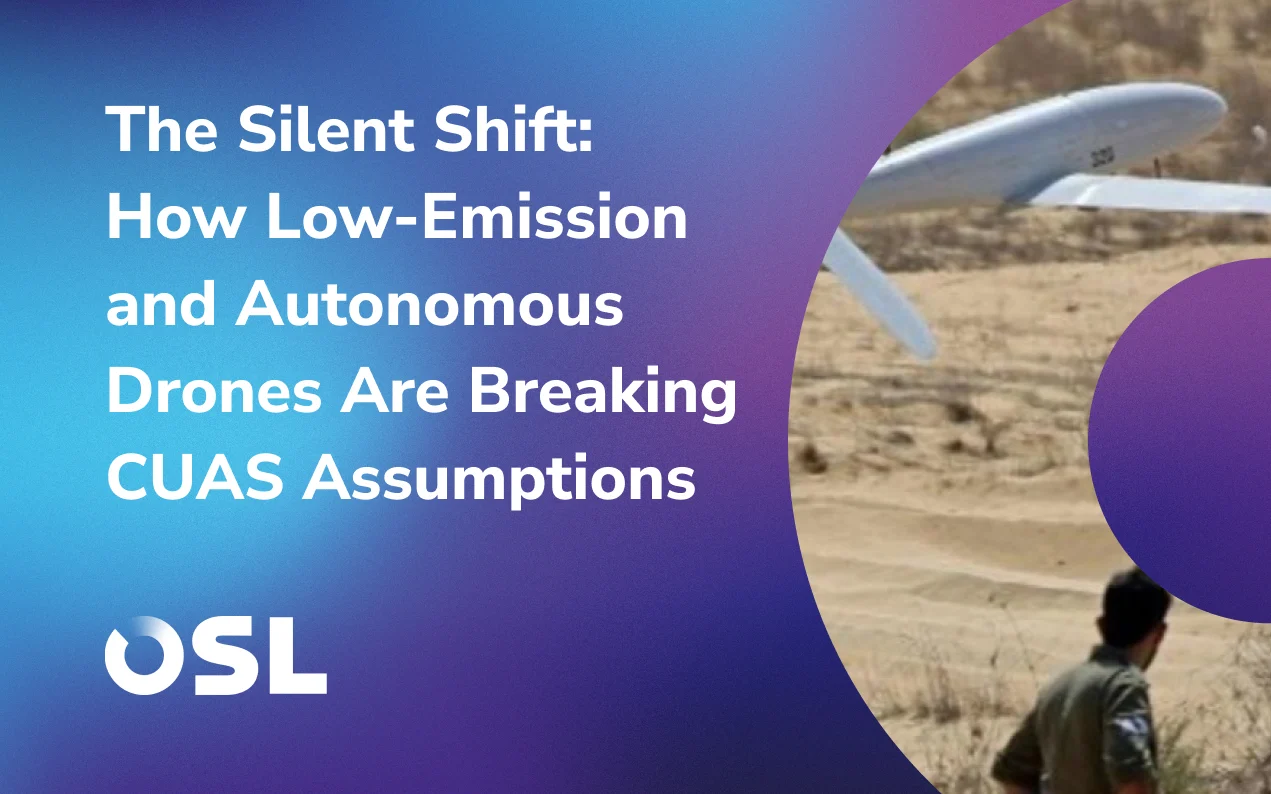
For many years, counter-uncrewed aircraft solutions were designed around a relatively stable understanding of the drone threat. Platforms were expected to emit detectable signals, behave in recognisable ways, and reveal intent early enough for operators to assess, verify, and respond.
These expectations defined CUAS effectiveness. They also shaped how teams evaluated drone detection effectiveness across airports, defence sites, and other complex environments. That model is now quietly eroding. The change has not arrived through a single dramatic leap, but through incremental shifts in how drones are designed and deployed.
Low-emission drones and low-observable drones are changing assumptions that CUAS operations have relied on for years. Detection may still occur, but clarity is harder to achieve, and confidence is harder to sustain. This raises new questions about the effectiveness of drone detection systems under evolving threat conditions.
This silent shift matters because it fundamentally changes how CUAS decision-making works in practice. The challenge extends beyond detecting drones. Systems must enable sound operational decision-making in airspace security when familiar signals are absent or delayed.
The assumptions that shaped CUAS design
Most CUAS deployments today are influenced by a small set of assumptions about how drone threats present themselves. These assumptions are rarely written, but they are embedded in alert logic, escalation workflows, and operator training.
One assumption is that drones flying will emit something useful for detection or classification. Radio-frequency control links, telemetry, or identifiable electronic signatures have traditionally supported drone detection effectiveness and early corroboration. Even when RF was not the main sensor, it often helped build confidence and support decision-making in drone surveillance.
A second assumption is that behaviour will be broadly predictable. Expected flight profiles and movement patterns have historically helped separate benign activity from deliberate threats, supporting decision-making in drone detection through gradual escalation.
A third assumption is that intent will reveal itself over time. Early detection, tracking, and correlation have helped operators confirm what they see before making urgent decisions. This process has been foundational to how decision-making in CUAS has functioned operationally.
Each of these assumptions still applies in some environments. However, they are becoming less dependable as low-emission drones, low signature drones, and autonomous behaviours become more common.
Low-emission drones and the erosion of early confidence
Low-emission drones are often discussed primarily as an RF challenge, but their impact goes well beyond the loss of a single signal type. When emissions are reduced or removed altogether, the entire process of building confidence changes.
Detection may still be possible through radar or electro-optical sensing, but corroboration often arrives later and with less context. Security teams may detect something, but struggle to understand what it is or why it is there. This gap directly affects CUAS decision-making and undermines long-held assumptions about CUAS effectiveness.
In practical terms, RF-silent drones shift CUAS operations away from identification and towards uncertainty management. The system may flag a potential threat, but without the explanatory signals that earlier models relied upon. Operators must make judgments with fewer familiar cues, increasing decision-making in drone defence.
This does not mean low-emission drones are invisible. It means the effectiveness of CUAS operations can no longer be judged only on whether an object was detected.
Autonomy and compressed decision timelines
Autonomous behaviour introduces a different and often more disruptive challenge. When low-emission drones operate without continuous external control, multiple traditional indicators disappear at once. There may be no continuous RF link, no observable operator behaviour, and no clear progression from reconnaissance to intrusion.
Instead, the drone appears where it was programmed to go and behaves consistently with its mission parameters. From an operational perspective, this removes layers of context that once supported verification and prioritisation. The result is a significant compression of decision timelines.
Operators may move rapidly from first detection to potential consequence, without the intermediate stages that previously supported deliberation. In these scenarios, decision-making in CUAS becomes less about perfect identification and more about determining when uncertainty itself represents unacceptable risk.
Many CUAS architectures rely on detection technologies, but struggle to express uncertainty in ways that genuinely support operational decision making in airspace security.
When “unknown” becomes the default state
One of the most significant consequences of these changes is subtle but important. In many cases, “unknown” is no longer a short-term condition. It is increasingly the default condition.
Modified platforms, RF-silent drones, autonomous navigation, and complex environments can make it hard to clearly identify a drone. In many cases, operators must act without full confirmation. Historically, unknowns were treated as gaps to be closed. Today, they often persist until the end of an incident.
This creates a new operational tension. Excessive caution risks delayed response, while excessive automation risks acting without sufficient justification. CUAS operations must balance responsibility and decisiveness in conditions where certainty is unattainable, reshaping how drone defence effectiveness is assessed in practice.
Detection alone is no longer the limiting factor
As sensing technologies have matured, raw detection capability has improved across many deployments. The harder problem now sits downstream of detection. This is where CUAS effectiveness is tested, by how clearly systems help operators turn detections into confident decisions.
What matters is whether systems help operators understand what they see and support response time for effective action. Low-emission drones expose weaknesses in CUAS designs that prioritise alert volume over clarity. When signals are weaker and timelines shorter, poorly structured information undermines CUAS effectiveness rather than improving it.
OSL explores this challenge by explaining why airspace security now relies more on verification rather than detection alone. Modern operations depend less on seeing more and more on understanding when airspace can be declared safe.
A conceptual shift in CUAS effectiveness
It is tempting to respond to these developments with purely technical fixes. Additional sensors and improved AI-driven algorithms play an important role, but the more fundamental shift required is conceptual.
From a long-term perspective, CUAS effectiveness can no longer focus only on early threat detection or perfect classification. It must also support decision-making in CUAS under ambiguity, time pressure, and incomplete information. That requires systems designed around human judgement as much as sensor performance.
This reframing aligns with broader defence analysis on autonomy and compressed decision cycles. Research published by NATO on autonomy and military decision-making highlights how uncertainty and time pressure increasingly shape operational outcomes in contested environments.
Low-emission drones are not breaking CUAS because they evade detection. They are breaking assumptions about how clarity is achieved and how confidence is built.
Preparing CUAS operations for what comes next
The silent shift underway does not demand alarmism or radical reinvention. It demands realism. CUAS operations must acknowledge that ambiguity is no longer an edge case, but a core operating condition.
Organisations that adapt successfully will focus less on promises of certainty. Instead, they prioritise supporting sound operational decision-making in airspace security when certainty is unavailable.
This includes revisiting assumptions about effectiveness of drone surveillance and decision-making in drone defence that no longer hold. This requires rethinking outdated assumptions about drone monitoring and decision-making in drone defence.
We explore these themes more in our recent blog. It looks at why people still believe in certainty, automation, and effectiveness, even when things have changed. In this context, airspace security is no longer defined by the effectiveness of drone surveillance. It is defined by how well it helps people decide what matters, when it matters most.
FAQs: CUAS effectiveness
How do low-emission drones affect CUAS operations?
Low-emission drones weaken or remove traditional detection signals like RF or telemetry. Operators must assess threats with limited context and act under uncertainty.
Why is autonomous drone behaviour a challenge for airspace security?
Autonomous drones fly without external control, removing predictable patterns and operator cues. This compresses decision timelines and raises the risk of delayed or wrong responses.
Can CUAS effectiveness rely on detection alone today?
No. Modern CUAS must detect drones and provide actionable insights. Operators need support to make confident decisions under ambiguity and time pressure.
How do commercial drones affect CUAS effectiveness today?
Commercial drones increasingly use autonomous flight modes and low-emission designs, which reduces observable signals and predictable behaviour. CUAS effectiveness relies on AI support. This helps operators make informed decisions for public safety, not just on detection.
How do drone swarms affect CUAS operations?
Drone swarms make things harder because many drones flying together are difficult to follow at the same time. This forces security teams to respond quickly with limited information.
Editor's Pick
.avif)
Secure your airspace with adaptive drone defence solutions
Ensure operational safety with multi-layered solutions designed to counter unauthorised drones and protect complex environments.