
Offshore Wind Needs a Counter Drone Ecosystem: Why Strategic Infrastructure Security Must Scale

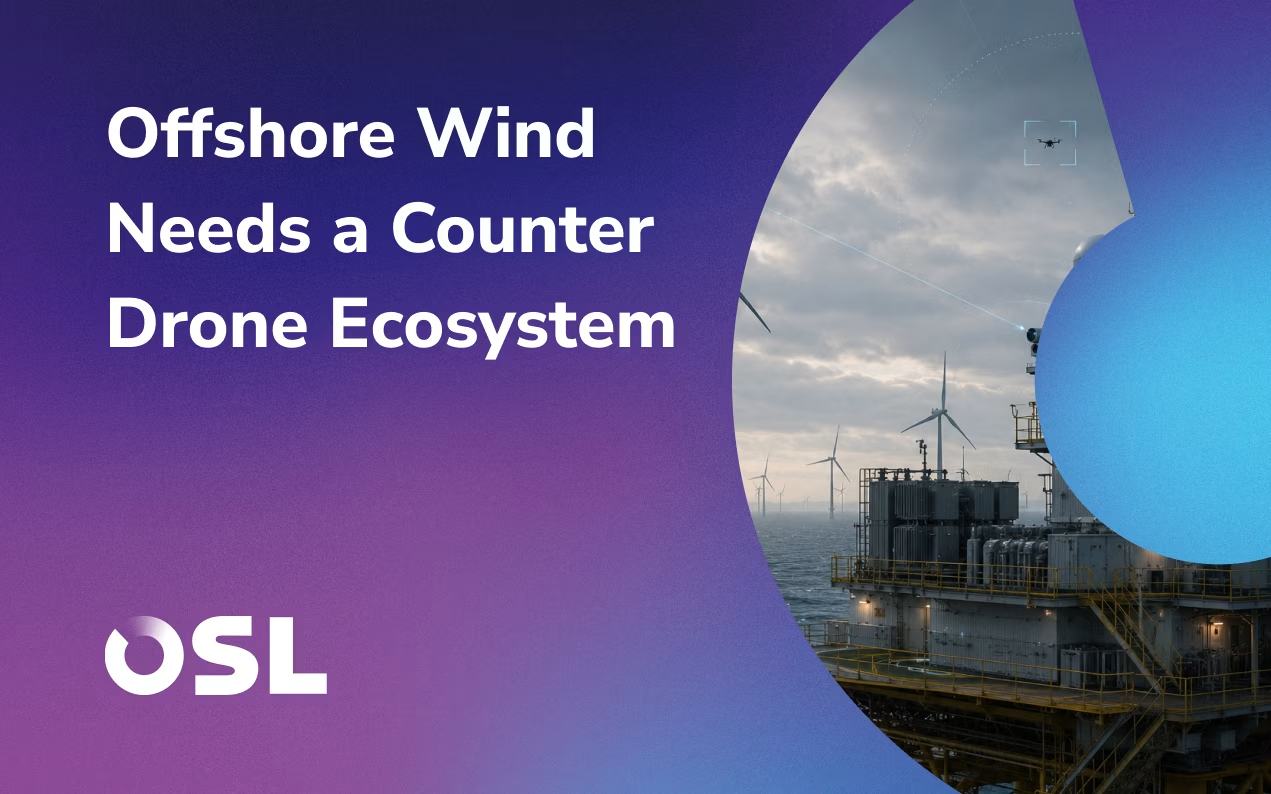
Offshore wind has entered a new phase. It is no longer simply a story of engineering excellence and decarbonisation, it is increasingly treated as strategic infrastructure. In the geopolitical climate of 2026, energy security is national security, and strategic infrastructure is expected to be resilient.
For decades, offshore installations were designed to withstand the forces of nature: extreme waves, salt-spray corrosion, North Sea gales. They were never designed to withstand adversaries. The transition from "power plant" to "strategic asset" demands a complete rethink of your surveillance and defence architecture.
If you operate or insure offshore assets, this is no longer abstract. Reported damage to subsea cables and pipelines in the Baltic and North Sea over the past two years, and the loitering vessel activity surrounding several of those incidents has made the threat tangible for every developer and grid operator in the region.
The Grey Zone of Maritime Hybrid Threats and Counter Drone Strategic Signals
Today, the vast network of wind farms, transformer platforms, and subsea cables faces hybrid threats that rarely announce themselves. These threats thrive in the "grey zone", the space where incidents look like accidents and ambiguity is the weapon.
An unauthorised drone flight near a substation, or a vessel loitering along a subsea cable route, is a counter-drone strategic signal indicating a move toward persistent probing of European energy sovereignty.
They are seldom isolated; more often, they are precursors to something larger. Industry bodies such as WindEurope now treat security and resilience as central investment themes rather than afterthoughts. That reflects how sharply the risk landscape has shifted.
Scaling protection in this environment requires an industrial counter-drone ecosystem anchoring strategy. You can no longer rely on fragmented, standalone sensors that cannot communicate across the vast distances of the North Sea or the Baltic.
The sector needs a resilient counter-drone industrial ecosystem in which hardware and software are built to survive and perform in some of the most hostile environments on earth. That ecosystem must deliver more than detection. It must produce evidence-based counter-drone signals that support a legally defensible response in international waters.
Why Traditional Perimeters Fail Against Counter Drone Threats Offshore
Offshore "perimeters" are conceptual at best. Unlike a fenced facility on land, a wind farm operates in an open maritime environment. Here, legitimate traffic and potential threats are constantly intermingled. Fishing vessels, maintenance craft, survey boats, and occasional hostile actors all share the same waters.
Worse, traditional electronic perimeter protection often monitors only the boundary structures, ignoring internal hostile build-up that can have catastrophic consequences. In high-traffic environments, false alarms from weather, birds, and sea clutter steadily erode your operator trust and attention.
When a system "cries wolf" often enough, the human operator becomes the weakest link in the chain. This is why autonomy-driven counter-drone frameworks are so critical offshore. They automate the correlation of radar, optical, thermal, and AIS data. This allows operators to act on verified targets rather than raw, noisy feeds.
By using AI-based signal processing to separate genuine threats from environmental clutter, you can restore the human operator to the centre of the decision loop - focused on response rather than detection.
Autonomy here is a force multiplier. It lowers the noise floor so that high-intent signals are identified before they reach the asset. OSL applies this logic precisely through its INSIGHT™ image analytics engine, which turns standard optical sensors into intelligent, automated detectors at the edge.
Offshore Counter Drone Resilience Through Sensor Fusion
The next generation of offshore protection is built around sensor fusion, treating radar, optical, thermal, and AIS inputs as parts of a single coherent system rather than separate feeds. Defence-grade radars provide the primary detection layer, tracking small targets in the worst possible weather. When that data is fused into one operating picture, the result is earlier warning and clearer classification at scale. This level of situational awareness is no longer a luxury; it is a fundamental requirement of national energy policy.
A resilient counter-drone industrial ecosystem ensures this technology is anchored in local R&D and industrial partnerships. OSL's position as a British specialist within the Terma Group - a company with deep heritage in naval and coastal surveillance radar - gives offshore operators exactly that anchored, sovereign foundation.
Fragmented regulation and fragmented technology together leave offshore wind exposed. A unified approach to wide-area surveillance, one that transcends borders and disciplines, is the answer. Security must be built into the wind farm from the outset. The shift is away from retrofitted sensors and toward integrated, intelligent defence architecture.
Intelligence, Not Just Detection
Offshore resilience ultimately depends on your ability to decide correctly with limited time and constrained access. There is no rapid response team a short drive away, and a transfer vessel may be hours from the platform in poor weather.
Reliable surveillance reduces noise, improves verification, and enables coordinated action while there is still time to act. As offshore wind becomes central to the European grid, its security posture must scale with the assets' strategic importance.
OSL works with operators across critical national infrastructure to make exactly that shift- from "watching for trouble" to maintaining a genuine exclusion zone through superior situational intelligence.
The operators who weather the next decade well will be those who treated a drone sighting near a transformer platform as the strategic signal it was, and acted early. Intelligence is the only real antidote to the ambiguity of hybrid warfare at sea.
Frequently Asked Questions: Counter Drone Strategic Autonomy
Why is offshore wind now considered strategic infrastructure?
Because energy security has become national security. Offshore wind farms, transformer platforms, and subsea cables now underpin the European grid. This makes them attractive targets for hybrid threats and a growing national resilience priority.
What are counter-drone strategic signals in a maritime context?
They are early indicators of hostile intent. These include an unauthorised drone near a substation or a vessel loitering along a cable route. Treated as strategic signals rather than isolated nuisances, they reveal patterns of persistent probing before a major incident occurs.
Why do traditional perimeters fail to protect offshore wind farms?
Offshore sites have no fence line. Legitimate and hostile traffic intermingle constantly, and boundary-only monitoring misses internal build-up. High false-alarm rates from weather and sea clutter then erode operator trust.
How does sensor fusion improve offshore counter-drone security?
Sensor fusion combines radar, optical, thermal, and AIS data into one coherent operating picture. This delivers earlier warning, clearer classification, and verified targets, so operators act on intelligence rather than raw, noisy feeds.
What operational gaps emerge when offshore CUAS systems rely on fragmented foreign-owned surveillance architecture?
When offshore CUAS systems rely on fragmented foreign-owned surveillance architecture, operators face poor interoperability between sensors. A sovereign counter-drone ecosystem reduces these risks by integrating detection, analytics, and decision-making into a more resilient and strategically autonomous architecture.
Editor's Pick


Secure your airspace with adaptive drone defence solutions
Ensure operational safety with multi-layered solutions designed to counter unauthorised drones and protect complex environments.