
Drone Swarms vs Coordinated Attacks: How Multi-Layered Defence Overcomes Airspace Saturation


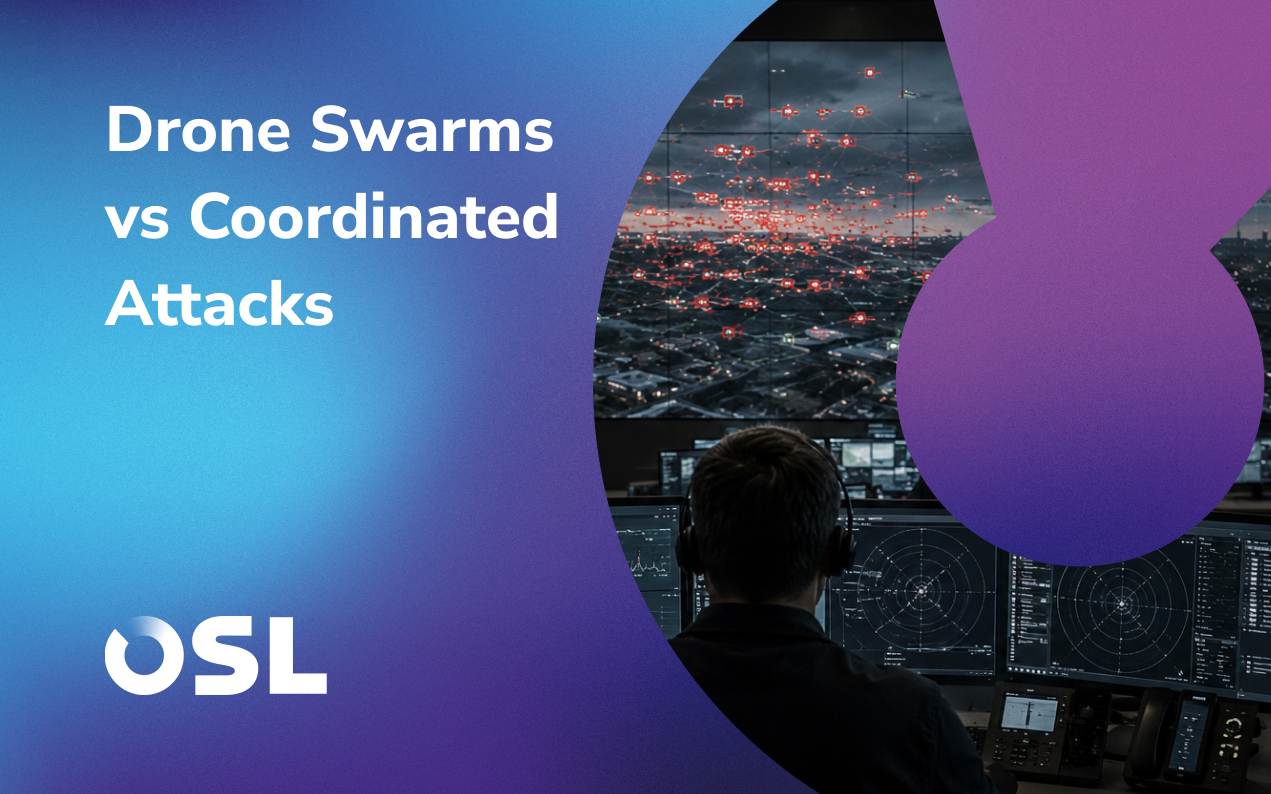
In lower airspace defence discussions today, a persistent terminology gap obscures the true nature of modern aerial warfare. Across media reports and industry briefings, the words swarm and coordinated attack are frequently used interchangeably. Treating these two distinct operational concepts as identical creates severe vulnerabilities in perimeter security and tactical planning.
To defend critical infrastructure and contested borders effectively, security leaders must separate buzzwords from engineering reality. Understanding the mechanical difference between autonomous AI swarm intelligence and a coordinated saturation attack is the first step toward building a resilient, scalable airspace defence grid.
Separating Signal from Noise on Europe's Eastern Flank
Before analysing high-volume multi-drone incursions, command rooms must first solve a foundational challenge: data clarity. The recent debate surrounding the shadow fleet report from the International Institute for Strategic Studies (IISS) sparked intense discussion across the European security community. The report suggested that Russian-linked merchant vessels served as launch platforms for 144 drone incursions across Europe.
Subsequent evaluation from independent bodies like the Dronewatch analysis highlighted a vital lesson: correlation does not equal causation. When physical evidence, thermal electro-optical imagery, infrared tracking, and radio frequency telemetry were examined in numerous high-profile incidents, reported drones turned out to be false alarms, standard commercial aircraft, or unverified atmospheric sightings.
When collaborating with defence partners along Europe's Eastern Flank, this exact operational reality dominates daily workflows. In a heightened threat environment, security teams face genuine tactical reconnaissance alongside the paralysing risk of false positive saturation. Without automated multi-sensor verification, treating every radar reflection or blinking light as a hostile aircraft collapses the defence system under cognitive fatigue.
Modern operators require an enduring partnership that delivers an integrated counter-drone command layer, fusing primary radar, signals intelligence, and optical sensors to confirm real-time threats.
True airspace resilience starts with the architectural trust needed to know with absolute mathematical certainty what's in your sky. Filtering out false alarms is only the first step in preparing for modern airspace threats.
Drone Swarm vs Coordinated Attack: Defining the Threat Landscape
Once a multi-drone incursion is verified as genuine, security directors must immediately distinguish between two threat profiles:
- The Coordinated Saturation Attack (The Multiple Threat): This involves multiple independent drones launched simultaneously or in rapid waves from different geographical points. Their flight paths are typically preset via GPS waypoints or managed by numerous individual pilots.
These machines do not communicate with one another. If defensive fire destroys the lead drone, the trailing aircraft have no awareness of the loss and continue blindly along their preprogrammed vectors.
- The True Autonomous Swarm (Decentralised Swarm Autonomy): A true swarm operates like a hive of bees. It functions as a single artificial organism through inter-drone mesh networking and AI swarm intelligence UAS protocols. Instead of a collection of individual drones, each unit in a swarm is dynamically affected by others' behaviour and positioning.
If defensive countermeasures neutralise three units in the formation, the remaining nodes communicate instantly. They automatically reconfigure their flight geometry and reallocate targets in real time without human intervention.
While autonomous swarm intelligence captures significant attention in speculative defence literature, our operational assessment focuses on immediate tactical reality. True self-adapting swarms are not yet a widespread operational threat to civilian infrastructure or tactical border installations today. The clear and present danger confronting perimeter security teams right now is the coordinated saturation attack.
The Wildebeest Math and the Trivial Saturation Scale
To understand the tactical threat of a coordinated attack, consider the wildebeest crossing philosophy observed in nature. When a massive herd crosses a predator-infested river simultaneously, predators can only capture a fraction. The majority survive and reach the opposite bank safely.
Modern asymmetric drone warfare executes this exact mathematical calculation against perimeter defences. Rather than seeking precision strike accuracy from every individual drone, an adversary relies on mathematical volume to saturate the defence channel and exhaust available defensive effectors. This can overwhelm human cognitive capacity, allowing a critical percentage of drones to breach the perimeter.
However, security leaders must recognise that saturation is a sliding scale, not an absolute number. For older, legacy defence systems or small commercial setups with limited tracking channels and manual workflows, achieving a fatal saturation attack can be surprisingly trivial.
If a legacy facility defence system only possesses two radio frequency mitigation channels or requires human operators to manually verify each target, an adversary doesn't need to launch one thousand drones to break through.
Launching just six to ten simple drones simultaneously creates an immediate operational overload. Even a small, low-cost multiple attack can therefore overwhelm outdated point defence infrastructure.
The Launch Bottleneck and Open Architecture
When electronic warfare countermeasures are restricted by regulation or bypassed by autonomous dark drones navigating via inertial guidance, kinetic physical interception becomes the primary line of defence. Managing these kinetic effectors presents a unique operational challenge.
Today, many advanced heavy lift interceptors still require a one-to-one pilot ratio for initial launch authorisation and takeoff clearance.
While manual pilot oversight is strictly necessary at the entry point of the engagement to ensure safety during launch, relying on manual piloting for mid-flight guidance creates a fatal bottleneck during an engagement against multi-vector drone threats.
Defending against dozens or hundreds of inbound drones with manual flight control workflows would require an impossible number of active pilots. Complicating this tactical reality is the ongoing expansion of the global defence sector, where procurement teams deal with fragmented hardware suites. Defending complex airspace requires an open counter-drone architecture.
By separating the software command layer from the physical sensor hardware, security leaders can integrate the best available radars, cameras, and kinetic effectors into a unified operating picture. This software approach prevents vendor lock-in and enables security directors to field layered CUAS technology across diverse environments.
When legacy infrastructure must operate alongside cutting-edge interceptors, an open architecture ensures seamless communication across the entire perimeter grid. It provides the foundation for scalable, enterprise-wide airspace security.
Scaling Defence with Person on the Loop Automation
You cannot defeat a saturation attack using purely manual command workflows or closed hardware tools. To survive multi-drone volume while respecting the necessity of initial pilot launch oversight, the engineering effort must shift upstream into an open software architecture that removes mid-flight human bottlenecks. The industry must transition from Person in the Loop oversight to Person on the Loop automation:
- Person in the Loop Architecture. The system automates target detection and tracking, but a human operator must explicitly approve every individual flight manoeuvre and gate in the engagement sequence before mitigation occurs. This approach remains appropriate for peacetime commercial facility protection and complex civilian airspace where continuous manual verification is mandatory.
- Person on the Loop Architecture. A human pilot initiates the sequence by authorising takeoff, ensuring compliance with launch safety rules. Once airborne, the software command layer manages global mission logic autonomously.
The system calculates flight trajectories, navigates complex no-fly zones, avoids legitimate air traffic, and authorises kinetic interceptors to use autonomous terminal guidance for final interception. The defensive sequence runs continuously at scale, neutralising threats automatically unless the human operator actively intervenes by exception.
Preparing for the Next Evolution in Airspace Defence
By combining an integrated counter-drone command layer with Person on the Loop automation, security teams move away from a fragile reliance on mid-flight pilot skill and toward systems-level certainty.
This structure allows operators to manage layered CUAS technology as a synchronised defensive grid. It provides the scaling power required to defeat today’s multi-vector saturation threats.
However, as intellectual leaders in airspace security, we must remain candid about the future of multi-drone warfare. While modern open architecture platforms are highly effective at breaking coordinated saturation engagements, the defence community can't state with absolute certainty that today's solutions will be fully ready for true, decentralised AI swarms once they emerge on the battlefield. As mesh networking and inter-drone autonomy mature, defensive architectures must continuously evolve to challenge formations where every aircraft dynamically influences the whole.
Whether defending a commercial facility against regional surveillance or protecting critical infrastructure from a coordinated saturation strike, legacy point defence tools and closed proprietary ecosystems are no longer sufficient.
Organisations evaluating their perimeter security must ensure their primary counter-drone system is built upon an open, sensor-agnostic architecture capable of filtering out false alarms with mathematical precision.
Furthermore, as adversaries scale the volume of aerial attacks, investing in scalable C-UAS solutions that bridge the gap between initial pilot oversight and Person on the Loop automation will be the deciding factor in maintaining airspace supremacy over the next decade.
Frequently Asked Questions
Why is saturation considered a sliding scale rather than a fixed number of drones?
Saturation depends entirely on the target system's defensive capacity. Military border installations may require hundreds of drones to overwhelm their multi-channel defences. However, older or smaller commercial defence systems can be overwhelmed by just a few drones. If a legacy system can track or mitigate only two targets at a time, launching just five coordinated drones can create a saturation breach.
What is the operational difference between a drone swarm and a coordinated saturation attack?
A coordinated saturation attack launches multiple independent drones along preset paths to overwhelm defensive sensors through sheer volume, without communicating with one another. However, a true drone swarm operates as an autonomous, decentralised network where drones use AI and mesh communications to influence and communicate. It can adapt its collective flight pattern in real time if individual drones are destroyed.
How does the wildebeest philosophy apply to modern drone warfare?
The wildebeest philosophy describes how an adversary launches massive numbers of inexpensive, independent drones through a narrow corridor simultaneously. The tactical objective is not individual precision, but overwhelming the mathematical capacity and defensive effectors of a security system. This allows a critical percentage of drones to reach the target.
Why is a one-to-one pilot ratio still relevant in automated counter-drone defence?
Automated software is required to manage mid-flight trajectory calculations and terminal guidance during mass attacks. However, human oversight remains vital at the loop's entry point. A human pilot must authorise initial launch and takeoff clearance before handing over execution to the automated command layer.
What is open counter-drone architecture?
Open counter-drone architecture is a software framework designed to integrate detection sensors and mitigation effectors from any manufacturer. By removing proprietary hardware restrictions, it lets security teams build customised, scalable airspace defence grids without vendor lock-in.
Are current counter-drone systems capable of defeating future autonomous swarms?
Today's advanced systems successfully defeat coordinated saturation attacks by using Person on the Loop automation to overcome human cognitive bottlenecks. The defence industry must continue evolving its capabilities.
True autonomous swarms feature inter-drone mesh networking, where units dynamically affect one another. Counter-drone architectures must therefore advance their sensor fusion and algorithms to prepare for these emerging decentralised threats.
Editor's Pick


Secure your airspace with adaptive drone defence solutions
Ensure operational safety with multi-layered solutions designed to counter unauthorised drones and protect complex environments.