
Beyond the Perimeter: What the Leipzig Incident Signals for Nationwide Airspace Defence


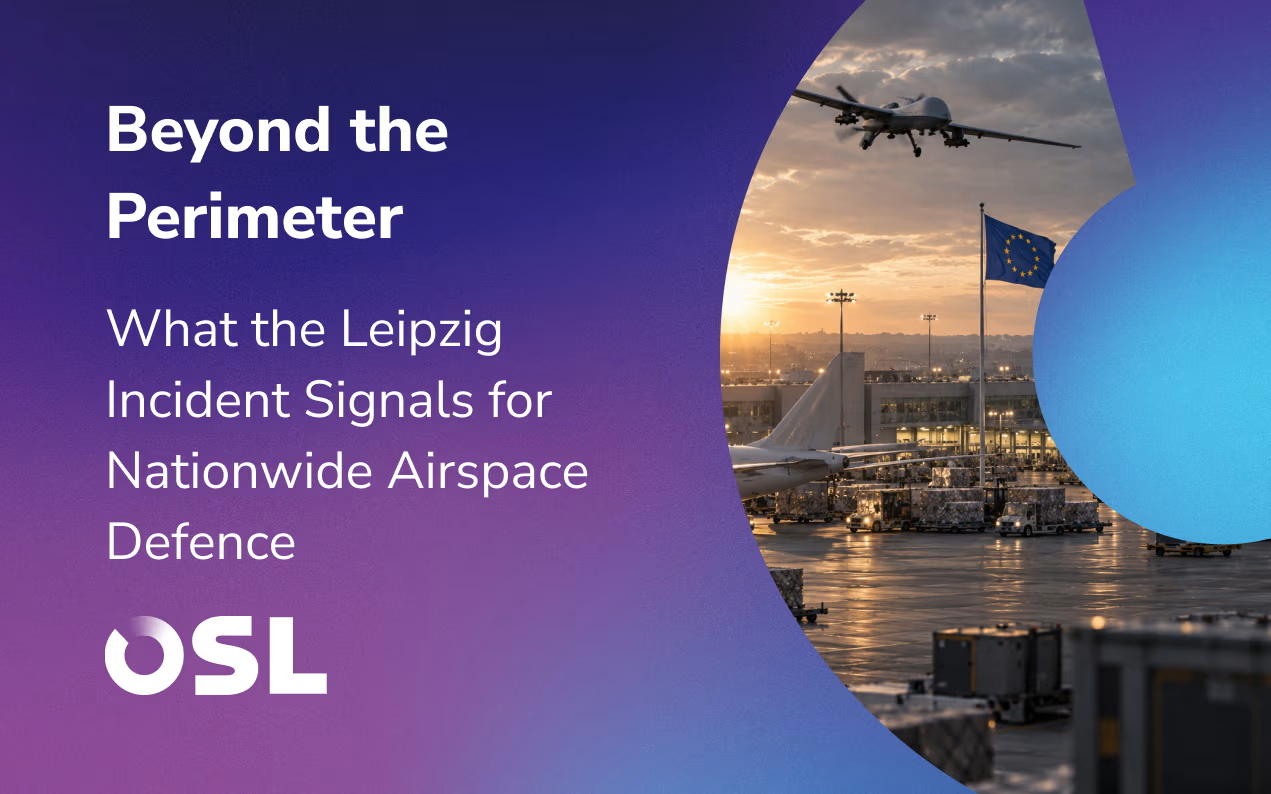
The aviation and defence sectors are standing at a critical inflection point. The recent discovery of an armed drone carrying explosives at Leipzig/Halle Airport has fundamentally altered the global conversation surrounding critical national infrastructure (CNI) security. As industry analysts recently highlighted regarding the cyber systems guarding modern airfields in The Sun, the threat vectors confronting transportation networks are evolving at a breakneck pace.
While initial reporting focused on flight delays, this event signals a far deeper structural shift. What the industry is witnessing is not an isolated breach. Instead, it is the definitive arrival of asymmetric, conflict-zone tactics in the civilian domain. Countering this new reality requires moving beyond isolated perimeter defences and adopting an integrated nationwide airspace defence architecture.
From Operational Disruption to Kinetic Warfare
For nearly a decade, the civilian counter-drone market has been shaped by the lessons of disruption. The Gatwick incident in 2018 showed how easily a rogue consumer UAV could paralyse a transport artery, inflicting massive financial losses without ever detonating a payload.
Leipzig represents an entirely different class of risk.
As a premier cargo hub supporting strategic military airlift operations, Leipzig/Halle occupies a dual-use posture critical to European supply chain resilience. The deliberate deployment of an explosive payload within this perimeter proves that hostile actors have pivoted from nuisance-level disruption to physical destruction and kinetic sabotage.
This shift toward kinetic intent was recently confirmed by German Chancellor Friedrich Merz, who stated that the attempted drone attack at Leipzig/Halle airport had been prepared in Russia over an extended period, with disaster only narrowly averted.
Security planners must recognise these incursions as advanced drone threats capable of exploiting the gaps between traditional ground security and conventional high-altitude air defence. Addressing this vulnerability demands a comprehensive rethink of large-scale airspace security.
Closing the Regulatory and Operational Void
Despite the rapid escalation of airborne threats, the civilian aviation sector continues to grapple with a critical regulatory deficit. Across international hubs, there remains a notable absence of standardised Key Performance Indicators (KPIs) for uncrewed airspace defence.
When security directors evaluate what constitutes an effective national CUAS, metrics often vary wildly. Does success mean achieving a specific detection range, minimising false alarms, or maintaining a sub-second response time?
Without harmonised operational frameworks, facilities risk deploying fragmented, siloed tools that fail to provide complete airspace sovereignty. Moving forward, the industry must establish verifiable benchmarks for system uptime and safe mitigation protocols. Resilience requires repeatable operational frameworks that scale across both commercial and sovereign boundaries.
Mastering the Operational Tempo: The Detect-to-Act Chain
As aerial threats become faster and more autonomous, the operational tempo of the defensive response must increase exponentially. In a modern threat scenario, detecting an airborne object is merely the opening second of a high-stakes sequence.
The real challenge is executing the response chain under intense time pressure: Detect, Track, Identify, Understand, Decide, and Act.
- Detect & Track: Early detection of micro-UAVs against radar ground clutter and urban noise.
- Identify & Understand: Differentiating between authorised commercial traffic and hostile intent through sensor fusion.
- Decide: Presenting clear, actionable telemetry to human operators to ensure defensible Rules of Engagement (ROE).
- Act: Instantly dispatching proportional countermeasures without endangering civilian bystanders.
To sustain this tempo, modern security hubs require workflows that instantly filter sensor noise and prioritise tracking. However, maintaining a human firmly in the loop remains an essential legal prerequisite in civilian airspace. An integrated command layer solves this balance by empowering operators with verified intelligence while automating the precision guidance of downstream effectors.
A Nationwide Response: Interoperability and Modern C2
Combating advanced airborne incursions has transcended the boundaries of localised base defence. A single airport cannot operate as an isolated defensive island. In response to widening vulnerabilities, European governments are procuring comprehensive, nationwide solutions.
A prime example of this paradigm shift is the move by defence authorities to deploy a fully interconnected counter-drone system across Denmark, creating a unified, sovereign drone situational picture across an entire nation. Building true resilience across such an extensive geographic footprint requires absolute CUAS interoperability.
At this scale, an effective Concept of Operations (CONOPS) must connect an unprecedented volume of heterogeneous assets. This means linking hundreds of distributed military radars, civilian air traffic management feeds, and optical sensors into a single multi-domain backbone. Crucially, this sensing fabric must be dynamically coupled with a diverse suite of effectors.
Achieving this level of coordination requires exceptional civil-military airspace integration. Security infrastructure can no longer exist in proprietary silos. By leveraging multi-sensor data fusion, modern command architectures eliminate communication bottlenecks between law enforcement, port authorities, and national defence forces. This delivers a single Common Operating Picture (COP) to every stakeholder.
This real-time situational awareness is the engine of a scalable CONOPS. When intelligence indicates a shifting threat vector, commanders can rapidly execute cross-agency drone defence. They can deploy mobile sensor units and redeployable effectors to emerging blind spots. True resilience lies in fusing an entire nation's assets into one cohesive network.
Strategic Procurement: The Imperative for Tech Agnosticity
Critical infrastructure operators cannot afford to lock themselves into closed, single-vendor ecosystems that become obsolete as commercial drone technologies pivot.
When evaluating long-term security investments, infrastructure directors should prioritise platforms that combine enterprise defence-grade scale with complete architectural agnosticity. A tech-agnostic command and control system allows operators to plug in the best-in-class radar or effector available today, while retaining the freedom to integrate emerging countermeasures tomorrow.
This strategic balance is accelerating industry consolidation. Established defence primes are increasingly acquiring specialised operational software leaders in the counter-drone space to bridge the gap between heavy hardware manufacturing and high-tempo software development. This ensures operators gain the financial backing of a major prime contractor without sacrificing modular flexibility.
Building the Operational Architecture of Tomorrow
The counter-drone industry spent its formative chapter demonstrating it could reliably identify unauthorised UAVs. The next chapter, accelerated by Leipzig, demands nation-scale operational architectures that can safely and seamlessly coordinate mitigation. The transition from localised perimeter security to sovereign airspace defence is an immediate operational mandate.
Frequently Asked Questions: National Security and Airspace Defence
Why are logistics hubs vulnerable to advanced drone threats?
Major logistics hubs manage high-density cargo, fuel storage facilities, and strategic transport corridors. Their vast physical perimeters and continuous operational schedules make them high-value targets for economic disruption and kinetic sabotage.
What is the significance of human-in-the-loop in civilian CUAS operations?
In civilian airspace, automated mitigation carries substantial risks of collateral damage or electronic interference. Keeping a human in the loop ensures rapid automated data processing, but a trained operator retains final authorisation over effector deployment, ensuring legal compliance.
How does national Counter-Unmanned Aircraft System differ from local airport security?
A localised system focuses on protecting a specific perimeter. A national CUAS integrates multiple distributed military, civil, and commercial sensors across a country into a C2 backbone, enabling coordinated responses across vast areas.
Why is CUAS interoperability vital for long-term airspace defence?
Drone technology evolves faster than traditional defence procurement cycles. High interoperability prevents vendor lock-in and allows facilities to continuously integrate new sensors and effectors as threats emerge.
What KPIs should airports use to measure CUAS effectiveness?
Airports should measure detection range, identification accuracy, response time, false-alarm rates, system uptime, and mitigation safety. These KPIs show whether a CUAS can track drone threats and support rapid responses without disrupting airport operations.
Editor's Pick
.avif)
Secure your airspace with adaptive drone defence solutions
Ensure operational safety with multi-layered solutions designed to counter unauthorised drones and protect complex environments.